

$30.00-$42.00/UNRESERVED SEATING/PLACES NON RÉSERVÉES
ELECTRONIC TICKETS/BILLETS ÉLECTRONIQUES
Buy Tickets / Acheter des billets
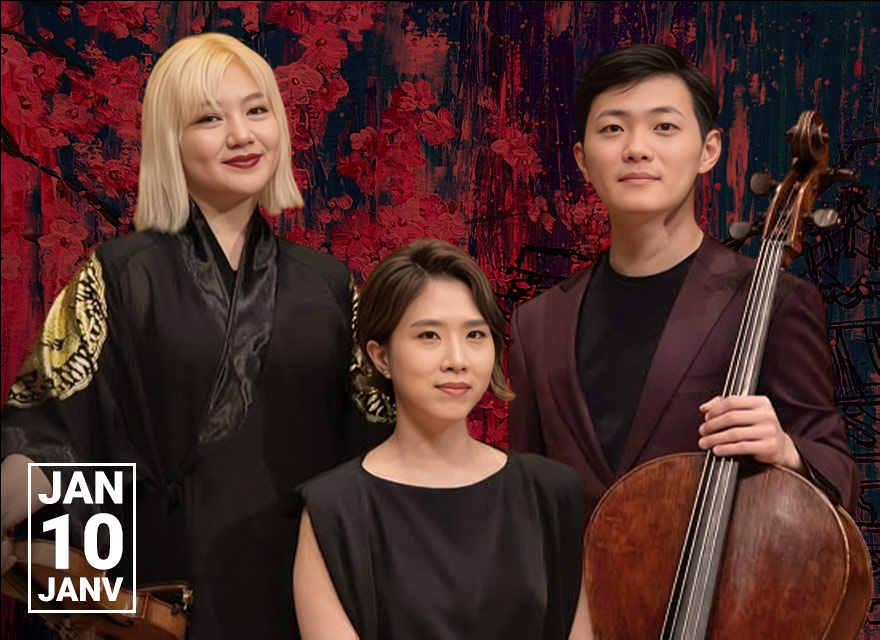
Trio Seoul : East Meets West
SATURDAY, JANUARY 10, 2026 • 7:30PM
STAGE AT ST. ANDREWS • 6036 COBURG RD
HALIFAX, NOVA SCOTIA
WHEELCHAIR ACCESSIBLE
About this Concert
Trio Seoul, featuring the masterful violinist Jinjoo Cho, the expressive cellist Brannon Cho, and the dynamic pianist Kyu Yeon Kim, presents a program that seamlessly blends their South Korean cultural heritage with contemporary innovation. These laureates of over 20 international competitions perform Joseph Haydn’s spirited Piano Trio No. 39 in G Major, “Gypsy,” with its graceful Andante, lyrical Poco adagio, cantabile, and exhilarating Rondo all’Ongarese, Presto. Juri Seo’s evocative “July Mountain” paints vivid scenes with “Metasequoia,” shimmering “Golden Bells,” and serene “Sonamu,” drawing inspiration from Korean landscapes. Franz Liszt’s melancholic “Tristia” adds reflective depth, while Maurice Ravel’s dazzling “Piano Trio,” a cornerstone of the chamber music repertoire that blends elegant melodies with intricate rhythms, highlights the trio’s technical precision and emotional range. With extensive experience on the world’s premier stages—from Carnegie Hall to Seoul Arts Center—Trio Seoul infuses their 21st-century vision and the pulsating energy of their namesake city into this captivating performance. Their imaginative interpretations and magnetic ensemble playing make for an unforgettable musical journey. Season Sponsor: Nice Moves / Red Door Realty.
This performance is made possible with the generous support of Marian Binkley, Barbara Cottrell, and Prindle Vaux.
ARTISTS: Jinjoo Cho, violin; Brannon Cho, cello; Kyu Yeon Kim, piano
MAIN STAGE CONCERTS SERIES
About the Program
Joseph Haydn (1732–1809)
Piano Trio No. 39 in G Major, ‘Gypsy’
I. Andante
II. Poco adagio, cantabile
III. Rondo all’Ongarese: Presto
Joseph Haydn was born to a working class family in a rural village near the Austrian-Hungarian border. While neither of his parents could read a note of music, the family sang together regularly and gave impromptu concerts with their neighbours. The musical gift was strong enough that both Joseph and his younger brother Michael had highly successful careers as musicians and composers. Both boys had beautiful voices and were recruited as boy sopranos to sing in “St. Stephen’s Cathedral” in Vienna. While their training there included voice and keyboard, Joseph claims to have taught himself counterpoint by studying the works of C.P.E. Bach, and once his voice changed and he was released from the choir, he had an arduous time trying to make a living as a musician. His career was established when, in 1766, he became Music Director for Prince Nicholas Esterhazy at his newly constructed estate, “Esterhaza”, located in the Hungarian countryside about 60 kilometres from Vienna. Haydn remained in this position for almost twenty-five years, until the death of Prince Nicholas in 1790. His role involved composing and conducting music for the Prince’s orchestra as well as for smaller chamber groups. He also composed and produced operas. It was a full and busy life, although the isolation was often irksome. By 1790, when he left “Esterhaza”, he was the most famous musician in Europe. In the 1790s, he made two extensive tours of England where his music was a fixture on every concert program. His death in 1809 was mourned throughout the continent.
Haydn wrote his “Piano Trio No. 39 in G Major” in 1795, during his second concert tour of England. It was premiered and published there that year. The opening “Andante” movement is a melodic and elegant set of theme and variations; the second movement is also gentle, more wistful, even romantic, with a lovely violin melody in the central section. The trio is often called the “Gypsy Rondo” or “Gypsy Trio” because the lively third movement incorporates a number of Gypsy tunes, including a Hungarian “recruiting dance”.
Juri Seo (born 1981)
July Mountain
I. “Metasequoiaxz
II. “Golden Bells”
III. “Sonamu”
Composer and pianist Juri Seo was born in South Korea on new Year’s Eve, 1981. She received a Music Baccalaureate from the prestigious “Yonsei University” in Seoul and studied at the “National Academy of St. Cecilia” in Rome prior to taking Masters and Doctoral degrees at the “University of Illinois”. She has received numerous awards, including a “Guggenheim Fellowship”. She is currently a professor on the Music Faculty at “Princeton University”. While she finds inspiration in traditional Korean music, her Princeton bio also notes “She merges many of the fascinating aspects of music from the past century…with a deep love of functional tonality, counterpoint, and classical form. With its fast-changing tempi and dynamics, her music explores the serious and the humorous, the lyrical and the violent, the tranquil and the obsessive.”
Juri Seo’s piano trio “July Mountain” is a cinematic soundscape inspired by Korean landscapes. Reviewers have found the piece both substantial and enjoyable. Premiered in Chicago in May 2025, “July Mountain” has already been programmed for a large number of concert series.
Franz Liszt (1811–1886)
“Tristia” (After “Vallée d’Obermann”), S. 723C
Franz Liszt was the outstanding piano virtuoso of the Nineteenth Century. As BBC commentator Jessica Duchen writes, “As a performer, he was unparalleled, capable of drawing gasps from audiences with sheer virtuosity, dazzling fingers flying across the keys with a speed and precision that seemed almost supernatural. People fainted at his concerts, scrambled for souvenirs of his gloves or hair, and packed concert halls to the rafters in a frenzy of adoration.”
Although he composed mostly for the piano, pieces he generally premiered himself on his concert tours, he helped redefine classical music, inventing the “Symphonic Poem” and developing the concept of the “Master Class”. Throughout, he was the quintessential artist of the “Romantic Movement”. He found inspiration for his compositions on the works of writers like Byron, Goethe and Schiller. For example, his suite of solo piano pieces, “Années de pèlerinage”, published in 1855, is clearly based on the Romantic literature of his time. In his Introduction to the piece, Liszt wrote, “Having recently travelled to many new countries, through different settings and places consecrated by history and poetry; having felt that the phenomena of nature and their attendant sights …. I have tried to portray in music a few of my strongest sensations and most lively impressions.”
“Tristia” is a piano trio “arrangement” of “Vallée d’Obermann”, the sixth piece in “Années de Pèlerinage”. It is inspired by Etienne de Senancour’s novel whose hero is overwhelmed and confused by nature, suffering from ennui and longing, finally concluding that only our feelings are true. Liszt’s student Edward Lassen made the arrangement for piano trio in 1880. It was then revised and edited by Liszt himself. “Tristia” is a hauntingly beautiful piece. Marked lento assai, it is a slow and melancholic piece reflecting the hero’s sense of longing and isolation.
Maurice Ravel (1875–1937)
Piano Trio in A Minor, M. 67
I. Modéré
II. Pantoum, Assez vif
III. Passacaille, Très large
IV. Final, Animé
Maurice Ravel was born in Ciboure, France, a Basque town eighteen kilometres from the Spanish border. His mother, also Basque, had been raised in Madrid. While the Ravel family moved to Paris before young Maurice was six months old, the Spanish influence shows up in his music time and again. It is the basis of his most familiar piece, “Bolero”, as well as “Rapsodie espagnole”, “Alborado del gracioso”, and “L’heure espagnole”. As a child, he was sensitive to music and loved the Spanish folk songs that his mother sang to him. He began to play piano at age seven, and went on to study composition and harmony in his early teens, receiving a grounding in classical Western forms. In fact, his earliest compositions were variations on music of Schumann and Grieg. By the time he was in his twenties, after his studies at the “Paris Conservatory”, he was well established as a musician in Paris circles.
Ravel was known as a painstaking craftsman as well as an innovator. He began work on the “Piano Trio in A minor” in March of 1914 and early in the summer, he remarked to a friend, “I’ve written my trio. Now all I need are the themes.” The traditional four movement structure was in place. He spent much of the summer working on the Trio while staying in the French Basque commune of “Saint-Jean-de-Luz”, near his birthplace. At the same time that he was working on the Trio, he was sketching material for a piano concerto based on Basque themes. Although the piano concerto was never completed, some of the Basque themes found their way into the opening movement of the Trio, which, Ravel noted, was “Basque in colouring”.
The second movement is labelled, “Pantoum” after the Malaysian poetic form that uses a system of interlocking lines. Ravel reflects the poetic form in the way he develops the movement’s two themes in alternation. The “Passacaglia” is the emotional heart of the work. The melody is passed between the three instruments, building to a powerful climax, then dying away. The final movement has an almost orchestral expanse. It is grand, stirring music composed on the eve, and in the shadow, of the “First World War”.
Program notes by Larry Bent
About the Artists
About Trio Seoul
Formed in 2022, Trio Seoul’s violinist Jinjoo Cho, cellist Brannon Cho, and pianist Kyu Yeon Kim are winners and laureates of more than 20 international competitions and awards combined. The ensemble was formed with a mission to combine forces between three members who identify as the 21st century musician, actively performing on the world's greatest concert halls while presenting creative projects in collaboration with artists of various fields including composers, choreographers, writers, and visual artists.
Jinjoo Cho, violin
Violinist Jinjoo Cho is a versatile classical virtuoso of the 21st Century. 1st Prize Winner of the “International Violin Competition of Indianapolis” in addition to “Montréal”, “Buenos Aires”, “Schoenfeld”, and “Stulberg International Competitions”, Jinjoo has performed on concert stages worldwide since the age of 11. Today, she continues to captivate audiences at renowned venues and festivals such as “Carnegie Hall’s Stern Auditorium”, the “Aspen Music Festival”, the “Gilmore Festival”, “La Jolla Music Society’s Summerfest”, the “Banff Centre”, “Festival de Lanaudière”, “La Seine Musicale”, the “Kronberg Academy”, “Schwetzingen Festspiele”, “Herkulessaal”, “Teatro Colón”, and the “Seoul Arts Center”.
A charismatic soloist, Jinjoo has appeared with leading orchestras such as The Cleveland Orchestra, Orchestre symphonique de Montréal, Deutsche Radio Philharmonic, Orquesta Clásica Santa Cecilia de Madrid, Ensemble Appassionato, Seoul Philharmonic, North Carolina, Phoenix, and Charlotte Symphonies, collaborating with renowned conductors such as James Gaffigan, Kent Nagano, JoAnn Falletta, Karina Canellakis, Mathieu Herzog, Peter Oundjian, Michael Stern, Tito Munoz, Michael Francis, Moritz Gnann, Shi-Yeon Sung, Pietari Inkinen, and Clemens Schuldt. Jinjoo has deep love and appreciation for the chamber music repertoire, and cherishes sharing the stage with prominent artists of the globe such as Gary Hoffman, Andreas Ottensamer, Ray Chen, Itamar Golan, Roger Tapping, Jaime Laredo, Sharon Robinson, Vadim Gluzman, and Clive Greensmith. In 2021, Jinjoo formed “Trio Seoul” with pianist Kyu Yeon Kim and cellist Brannon Cho.
In addition to being an active performer, Jinjoo is a dedicated educator. She is currently an Associate Professor of Violin at the “Bienen School of Music” at “Northwestern University”. Her previous teaching positions include the “Schulich School of Music” at “McGill University”, “Cleveland Institute of Music”, and “Oberlin Conservatory”. Jinjoo frequently serves on the jury panels of international competitions such as the “Sibelius Competition” (Finland, 2025), “Indianapolis Competition” (USA, 2022), and “Schoenfeld Competition” (China, 2024), as well as on screening committees for the “Isang Yun Competition” (Korea, 2024), “Premio Paganini” (Italy, 2023), and “Montréal Competition” (Canada, 2019). Her commitment to nurturing young musicians is inspired by her own mentors, Paul Kantor and Jaime Laredo.
Jinjoo’s dedication to music extends beyond performance and teaching. In 2015, she founded the “ENCORE Chamber Music Institute” in Cleveland, Ohio, a summer festival and seasonal residency series that brings together international artists and talented students for intensive learning and performance experience. Her creative ventures also include commissioning new works from composers Juri Seo and Andrew Rindfleisch, as well as collaborating with artists from other disciplines, such as dancer/choreographer Jinyeob Cha. In 2021, her debut book, “Shine Someday”, became a bestseller on major Korean book platforms.
A distinguished recording artist, Jinjoo has released six albums: “Novella” (SONY), “Toy Store” (Carrier Records), “Saint-Saëns” (Naïve Classique), “La Capricieuse” (SONY Classical), “The Indianapolis Commissions” (Azica), and “Jinjoo Cho” (Analekta). Described as “a delectable curtain-raiser” (Strad Magazine) and “finest silk thread of a violin tone” (Rondo Magazine), Jinjoo’s discography has garnered critical acclaim worldwide as well as commercial success.
Brannon Cho, cello
Brannon Cho is the First Prize winner of the prestigious 6th “International Paulo Cello Competition”, and is also a top prize winner of the “Queen Elisabeth”, “Naumburg”, and “Cassadó International Cello Competitions”.
Most recently, Brannon Cho is the recipient of the 2020 “Janos Starker Foundation Award”, the “Landgraf von Hessen Prize” from “Kronberg Academy”, the 2019 “Ivan Galamian Award” previously held by James Ehnes, and is a scholarship holder in the “Anne-Sophie Mutter Foundation”.
Brannon Cho has appeared as a soloist with many of the top orchestras around the world, including the “Helsinki Philharmonic Orchestra”, “Minnesota Orchestra”, “Chamber Orchestra of Europe”, “Belgian National Orchestra”, “Tokyo Philharmonic Orchestra”, and “Brussels Philharmonic”.
Born in New Jersey, Brannon Cho received his Bachelor’s degree from “Northwestern University’s Bienen School of Music” under Hans Jørgen Jensen. He was awarded the “Artist Diploma” from the “New England Conservatory”, where he studied with Laurence Lesser. Today, he is in the “Professional Studies” program at the “Kronberg Academy”, under the tutelage of Frans Helmerson. Brannon Cho performs on a rare cello made by Antonio Casini in 1668 in Modena, Italy.
Kyu Yeon Kim, piano
Kyu Yeon Kim is among the prize winners of the “Dublin International Piano Competition” (2nd Prize, Concerto Prize, Mozart Prize), “Queen Elisabeth International Music Competition” (Laureate), “Cleveland International Piano Competition” (4th Prize, Mozart Prize), “Gina Bachauer International Young Artists Piano Competition” (1st Prize), “Geneva International Music Competition” (Special Prize), “Missouri Southern International Piano Competition” (2nd Prize) and “Bartok-Kabalevsky-Prokofiev International Piano Competition” (1st Prize).
Kyu Yeon has performed throughout the United States, Europe, and Asia in such venues as “Carnegie Hall”, “Lincoln Center”, “Kennedy Center”, “Severance Hall”, “BOZAR”, “Jordan Hall”, “Seoul Arts Center”, the “Grand Hall of the Moscow Conservatory”, “New World Center” in Miami, “Penderecki European Centre for Music”, “TivoliVredenburg” in Utrecht and “Opera de Rennes”.
She has appeared as a soloist with a number of orchestras, including the “Philadelphia Orchestra”, “Cleveland Orchestra”, “New World Symphony”, “National Orchestra of Belgium”, “Seoul Philharmonic Orchestra”, “Sinfonietta Cracovia”, “Utah Symphony Orchestra”, “Orchestre Royal de Chambre de Wallonie”, “Hungarian Chamber Orchestra”, “KBS Symphony Orchestra” and the “RTE National Symphony Orchestra”. As an avid chamber musician, she has collaborated with Arto Noras, Roberto Diaz, Ralf Gothoni, Michel Lethiec, Ju-Young Baek and Elina Vahala and was invited to perform at the “Casals Festival” in France, “Emanacje Festival” in Poland, “Great Mountains Winter Festival”, “Seoul Spring Festival”, and “Seoul International Music Festival”.
Born in Seoul, Kyu Yeon Kim studied at the “Korea National University of Arts” with Choong-Mo Kang and later at the “Universität der Künste” in Berlin with Klaus Hellwig, at the “Curtis Institute” with Gary Graffman, and at the “New England Conservatory” with Russell Sherman. She studied at the “International Piano Academy Lake Como” and earned “Artist Diploma” at the “Cleveland Institute of Music” under the guidance of Sergei Babayan. She got a doctorate degree at the “Manhattan School of Music” with Solomon Mikowsky.
Her debut album “Rameau & Schubert” was released by DUX label in Poland and distributed by NAXOS in the United States in 2017. Currently, she is a member of “Opus Ensemble” and a music director of “Young Classical Artists Foundation”.
Trio Séoul : « L'Orient rencontre l'Occident »
SAMEDI 10 JANVIER 2026 • 19h30
STAGE AT ST. ANDREWS • 6036 COBURG RD
HALIFAX, NOUVELLE-ÉCOSSE
ACCESSIBLE EN FAUTEUIL ROULANT
À propos de ce concert
Trio Seoul, composé de la violoniste accomplie Jinjoo Cho, du violoncelliste expressif Brannon Cho et de la pianiste dynamique Kyu Yeon Kim, présente un programme qui marie avec naturel leur héritage culturel sud-coréen et une approche résolument contemporaine. Lauréats de plus de 20 concours internationaux, ils interprètent le Trio pour piano no 39 en sol majeur de Joseph Haydn, « Gypsy », avec son Andante élégant, son Poco adagio cantabile d’un grand lyrisme et son Rondo all’Ongarese, Presto, à l’énergie irrésistible. « July Mountain » de Juri Seo évoque des paysages saisissants à travers les mouvements « Metasequoia », « Golden Bells » et « Sonamu », puisant son inspiration dans les paysages coréens. « Tristia » de Franz Liszt apporte une profondeur méditative, tandis que le Trio pour piano de Maurice Ravel, œuvre phare du répertoire de musique de chambre alliant mélodies raffinées et rythmes complexes, met en valeur la précision technique et l’étendue expressive de l’ensemble. Fort de sa présence sur les plus grandes scènes du monde, de Carnegie Hall au Seoul Arts Center, Trio Seoul insuffle à ce concert une vision du XXIe siècle et l’énergie vibrante de la ville qui lui donne son nom. Leurs interprétations inventives et leur cohésion remarquable promettent un parcours musical mémorable. Sponsor de la saison : Nice Moves / Red Door Realty.
Cette représentation est rendue possible grâce au soutien généreux de Marian Binkley, Barbara Cottrell et Prindle Vaux.
ARTISTES : Jinjoo Cho, violon ; Brannon Cho, violoncelle ; Kyu Yeon Kim, piano
SÉRIE DE CONCERTS SUR LA SCÈNE PRINCIPALE
À propos du programme
Joseph Haydn (1732–1809)
« Piano Trio No. 39 en sol majeur, “Gypsy” »
I. Andante
II. Poco adagio, cantabile
III. Rondo all’Ongarese : Presto
Joseph Haydn est né dans une famille de la classe ouvrière, dans un village rural près de la frontière austro-hongroise. Bien qu’aucun de ses parents ne sache lire une note de musique, la famille chantait ensemble régulièrement et donnait des concerts improvisés avec les voisins. Le don musical était suffisamment fort pour que Joseph et son jeune frère Michael aient tous deux des carrières hautement réussies comme musiciens et compositeurs. Les deux garçons avaient de belles voix et ont été recrutés comme sopranos enfants pour chanter à la « Cathédrale Saint-Étienne » de Vienne. Même si leur formation y comprenait le chant et le clavier, Joseph affirme avoir appris le contrepoint de façon autodidacte en étudiant les œuvres de C.P.E. Bach. Lorsque sa voix a mué et qu’il a été libéré de la chorale, il a eu beaucoup de difficulté à gagner sa vie comme musicien. Sa carrière s’est établie lorsqu’en 1766, il est devenu directeur musical du prince Nicolas Esterházy dans son domaine nouvellement construit, « Esterhaza », situé dans la campagne hongroise à environ 60 kilomètres de Vienne. Haydn est resté en poste pendant près de vingt-cinq ans, jusqu’à la mort du prince Nicolas en 1790. Son rôle consistait à composer et à diriger la musique pour l’orchestre du prince, ainsi que pour de plus petits ensembles de chambre. Il a aussi composé et produit des opéras. C’était une vie riche et occupée, même si l’isolement était souvent irritant. En 1790, au moment où il a quitté « Esterhaza », il était le musicien le plus célèbre d’Europe. Dans les années 1790, il a effectué deux vastes tournées en Angleterre, où sa musique figurait à tous les programmes de concert. Sa mort, en 1809, a été pleurée partout sur le continent.
Haydn a composé son « Piano Trio No. 39 en sol majeur » en 1795, lors de sa deuxième tournée de concerts en Angleterre. L’œuvre y a été créée et publiée la même année. Le mouvement d’ouverture, « Andante », est une série mélodique et raffinée de thème et variations. Le deuxième mouvement est lui aussi doux, plus rêveur, voire romantique, avec une belle mélodie de violon dans la section centrale. On appelle souvent ce trio le « Gypsy Rondo » ou le « Gypsy Trio », parce que le troisième mouvement, animé, intègre plusieurs airs tsiganes, dont une « danse de recrutement » hongroise.
Juri Seo (née en 1981)
« July Mountain »
I. « Metasequoia »
II. « Golden Bells »
III. « Sonamu »
La compositrice et pianiste Juri Seo est née en Corée du Sud le soir du Nouvel An, en 1981. Elle a obtenu un baccalauréat en musique à la prestigieuse « Yonsei University » de Séoul, puis a étudié à la « National Academy of St. Cecilia » de Rome avant de poursuivre une maîtrise et un doctorat à la « University of Illinois ». Elle a reçu de nombreux prix et distinctions, dont une « Guggenheim Fellowship ». Elle est actuellement professeure à la faculté de musique de la « Princeton University ». Tout en puisant une partie de son inspiration dans la musique traditionnelle coréenne, sa biographie à Princeton précise aussi : « She merges many of the fascinating aspects of music from the past century…with a deep love of functional tonality, counterpoint, and classical form. With its fast-changing tempi and dynamics, her music explores the serious and the humorous, the lyrical and the violent, the tranquil and the obsessive. »
Le trio pour piano « July Mountain » de Juri Seo est un paysage sonore cinématographique inspiré des paysages coréens. Les critiques ont salué l’œuvre pour sa richesse et son pouvoir d’évocation. Créé à Chicago en mai 2025, « July Mountain » a déjà été repris par de nombreuses séries de concerts.
Franz Liszt (1811–1886)
« Tristia » (d’après « Vallée d’Obermann »), S. 723C
Franz Liszt fut le grand virtuose du piano du XIXe siècle. Comme l’écrit la commentatrice de la BBC Jessica Duchen : « As a performer, he was unparalleled, capable of drawing gasps from audiences with sheer virtuosity, dazzling fingers flying across the keys with a speed and precision that seemed almost supernatural. People fainted at his concerts, scrambled for souvenirs of his gloves or hair, and packed concert halls to the rafters in a frenzy of adoration. »
Bien qu’il ait composé surtout pour le piano, des pièces qu’il créait généralement lui-même lors de ses tournées, il a contribué à redéfinir la musique classique en inventant le « poème symphonique » et en développant le concept de la « master class ». Tout au long de sa vie, il a incarné l’artiste par excellence du « mouvement romantique ». Il a trouvé l’inspiration pour ses compositions dans les œuvres d’écrivains comme Byron, Goethe et Schiller. Par exemple, son recueil de pièces pour piano seul, « Années de pèlerinage », publié en 1855, s’inscrit clairement dans la littérature romantique de son époque. Dans l’introduction de l’œuvre, Liszt écrit : « Having recently travelled to many new countries, through different settings and places consecrated by history and poetry; having felt that the phenomena of nature and their attendant sights …. I have tried to portray in music a few of my strongest sensations and most lively impressions. »
« Tristia » est un « arrangement » pour trio avec piano de « Vallée d’Obermann », la sixième pièce des « Années de pèlerinage ». L’œuvre s’inspire du roman d’Étienne de Senancour, dont le héros est submergé et confus devant la nature, souffrant d’ennui et de désir, pour finalement conclure que seuls nos sentiments sont vrais. L’élève de Liszt, Edward Lassen, a réalisé l’arrangement pour trio avec piano en 1880. Liszt l’a ensuite révisé et édité lui-même. « Tristia » est une œuvre d’une beauté troublante. Marquée lento assai, c’est une pièce lente et mélancolique, qui reflète le sentiment de désir et d’isolement du héros.
Maurice Ravel (1875–1937)
« Piano Trio en la mineur », M. 67
I. Modéré
II. Pantoum, Assez vif
III. Passacaille, Très large
IV. Final, Animé
Maurice Ravel est né à Ciboure, en France, une ville basque située à dix-huit kilomètres de la frontière espagnole. Sa mère, également basque, avait grandi à Madrid. Même si la famille Ravel a déménagé à Paris avant que le jeune Maurice n’ait six mois, l’influence espagnole revient sans cesse dans sa musique. Elle est au cœur de sa pièce la plus connue, « Bolero », ainsi que de « Rapsodie espagnole », « Alborado del gracioso » et « L’heure espagnole ». Enfant, il était sensible à la musique et aimait les chansons folkloriques espagnoles que sa mère lui chantait. Il a commencé le piano à l’âge de sept ans, puis a étudié la composition et l’harmonie au début de son adolescence, acquérant une solide formation dans les formes classiques occidentales. En fait, ses premières compositions étaient des variations sur des musiques de Schumann et de Grieg. Dans la vingtaine, après ses études au « Conservatoire de Paris », il était déjà bien établi dans les milieux parisiens.
Ravel était reconnu comme un artisan méticuleux, autant qu’un innovateur. Il a commencé à travailler à son « Piano Trio en la mineur » en mars 1914 et, au début de l’été, il a confié à un ami : « I’ve written my trio. Now all I need are the themes. » La structure traditionnelle en quatre mouvements était déjà en place. Il a passé une bonne partie de l’été à travailler au Trio, tout en séjournant dans la commune basque française de « Saint-Jean-de-Luz », près de son lieu de naissance. Au même moment, il esquissait du matériau pour un concerto pour piano basé sur des thèmes basques. Bien que ce concerto n’ait jamais été terminé, certains de ces thèmes basques se sont retrouvés dans le mouvement d’ouverture du Trio, que Ravel décrivait comme « Basque in colouring ».
Le deuxième mouvement porte le titre de « Pantoum », en référence à la forme poétique malaise qui utilise un système de vers entrelacés. Ravel reflète cette forme dans sa manière de développer en alternance les deux thèmes du mouvement. La « Passacaille » constitue le cœur émotionnel de l’œuvre. La mélodie circule entre les trois instruments, s’amplifie jusqu’à un climax puissant, puis s’éteint. Le mouvement final déploie une ampleur presque orchestrale. C’est une musique grandiose et entraînante, composée à la veille, et sous l’ombre, de la « Première Guerre mondiale ».
Notes de programme par Larry Bent
À propos des artistes
À propos du Trio Seoul
Fondé en 2022, le Trio Seoul réunit la violoniste Jinjoo Cho, le violoncelliste Brannon Cho et la pianiste Kyu Yeon Kim, lauréats et gagnants de plus de 20 concours et prix internationaux à eux trois. L’ensemble a été créé avec la mission de réunir trois artistes qui se définissent comme des musiciens du XXIe siècle, se produisant activement dans les plus grandes salles de concert du monde, tout en présentant des projets créatifs en collaboration avec des artistes de divers domaines, dont des compositeurs, des chorégraphes, des écrivains et des artistes visuels.
Jinjoo Cho, violon
La violoniste Jinjoo Cho est une virtuose classique polyvalente du XXIe siècle. Lauréate du 1er prix de l’« International Violin Competition of Indianapolis », ainsi que des concours « Montréal », « Buenos Aires », « Schoenfeld » et « Stulberg International Competitions », Jinjoo se produit sur les scènes du monde entier depuis l’âge de 11 ans. Aujourd’hui, elle continue de captiver le public dans des lieux et festivals reconnus, tels que « Carnegie Hall’s Stern Auditorium », le « Aspen Music Festival », le « Gilmore Festival », « La Jolla Music Society’s Summerfest », le « Banff Centre », le « Festival de Lanaudière », « La Seine Musicale », la « Kronberg Academy », « Schwetzingen Festspiele », « Herkulessaal », « Teatro Colón » et le « Seoul Arts Center ».
Soliste charismatique, Jinjoo s’est produite avec de grands orchestres, dont The Cleveland Orchestra, l’Orchestre symphonique de Montréal, la Deutsche Radio Philharmonic, l’Orquesta Clásica Santa Cecilia de Madrid, l’Ensemble Appassionato, le Seoul Philharmonic, ainsi que les orchestres symphoniques de North Carolina, Phoenix et Charlotte, en collaboration avec des chefs renommés tels que James Gaffigan, Kent Nagano, JoAnn Falletta, Karina Canellakis, Mathieu Herzog, Peter Oundjian, Michael Stern, Tito Munoz, Michael Francis, Moritz Gnann, Shi-Yeon Sung, Pietari Inkinen et Clemens Schuldt. Jinjoo porte un profond amour au répertoire de musique de chambre et chérit le fait de partager la scène avec des artistes de premier plan, tels que Gary Hoffman, Andreas Ottensamer, Ray Chen, Itamar Golan, Roger Tapping, Jaime Laredo, Sharon Robinson, Vadim Gluzman et Clive Greensmith. En 2021, Jinjoo a formé le « Trio Seoul » avec la pianiste Kyu Yeon Kim et le violoncelliste Brannon Cho.
En plus d’être une interprète active, Jinjoo est une pédagogue engagée. Elle est actuellement professeure agrégée de violon à la « Bienen School of Music » de la « Northwestern University ». Elle a auparavant enseigné à la « Schulich School of Music » de la « McGill University », au « Cleveland Institute of Music » et à l’« Oberlin Conservatory ». Jinjoo siège fréquemment à des jurys de concours internationaux tels que le « Sibelius Competition » (Finlande, 2025), l’« Indianapolis Competition » (États-Unis, 2022) et le « Schoenfeld Competition » (Chine, 2024), ainsi qu’à des comités de présélection pour l’« Isang Yun Competition » (Corée, 2024), le « Premio Paganini » (Italie, 2023) et le « Montréal Competition » (Canada, 2019). Son engagement envers les jeunes musiciens est inspiré par ses propres mentors, Paul Kantor et Jaime Laredo.
L’engagement de Jinjoo envers la musique va au-delà de l’interprétation et de l’enseignement. En 2015, elle a fondé l’« ENCORE Chamber Music Institute » à Cleveland, en Ohio, un festival d’été et une série de résidences saisonnières qui réunissent des artistes internationaux et des étudiants talentueux pour une expérience d’apprentissage et de performance intensive. Ses projets créatifs comprennent aussi la commande de nouvelles œuvres auprès des compositeurs Juri Seo et Andrew Rindfleisch, ainsi que des collaborations avec des artistes d’autres disciplines, dont le danseur et chorégraphe Jinyeob Cha. En 2021, son premier livre, « Shine Someday », est devenu un best-seller sur les principales plateformes de livres en Corée.
Artiste enregistrée reconnue, Jinjoo a publié six albums : « Novella » (SONY), « Toy Store » (Carrier Records), « Saint-Saëns » (Naïve Classique), « La Capricieuse » (SONY Classical), « The Indianapolis Commissions » (Azica) et « Jinjoo Cho » (Analekta). Décrite comme « a delectable curtain-raiser » (Strad Magazine) et « finest silk thread of a violin tone » (Rondo Magazine), sa discographie a reçu un accueil critique enthousiaste à l’échelle mondiale, ainsi qu’un succès commercial.
Brannon Cho, violoncelle
Brannon Cho est lauréat du premier prix du prestigieux 6e « International Paulo Cello Competition » et a également remporté des prix de haut niveau aux concours « Queen Elisabeth », « Naumburg » et « Cassadó International Cello Competitions ».
Plus récemment, Brannon Cho a reçu le « Janos Starker Foundation Award » en 2020, le « Landgraf von Hessen Prize » de la « Kronberg Academy », le « Ivan Galamian Award » 2019, auparavant décerné à James Ehnes, et il est boursier de l’« Anne-Sophie Mutter Foundation ».
Brannon Cho s’est produit comme soliste avec plusieurs des plus grands orchestres du monde, dont le « Helsinki Philharmonic Orchestra », le « Minnesota Orchestra », le « Chamber Orchestra of Europe », le « Belgian National Orchestra », le « Tokyo Philharmonic Orchestra » et le « Brussels Philharmonic ».
Né au New Jersey, Brannon Cho a obtenu son baccalauréat à la « Northwestern University’s Bienen School of Music » auprès de Hans Jørgen Jensen. Il a obtenu l’« Artist Diploma » du « New England Conservatory », où il a étudié avec Laurence Lesser. Aujourd’hui, il poursuit le programme « Professional Studies » de la « Kronberg Academy », sous la direction de Frans Helmerson. Brannon Cho joue sur un violoncelle rare fabriqué par Antonio Casini en 1668 à Modène, en Italie.
Kyu Yeon Kim, piano
Kyu Yeon Kim figure parmi les lauréates des concours « Dublin International Piano Competition » (2e prix, Concerto Prize, Mozart Prize), « Queen Elisabeth International Music Competition » (lauréate), « Cleveland International Piano Competition » (4e prix, Mozart Prize), « Gina Bachauer International Young Artists Piano Competition » (1er prix), « Geneva International Music Competition » (Special Prize), « Missouri Southern International Piano Competition » (2e prix) et « Bartok-Kabalevsky-Prokofiev International Piano Competition » (1er prix).
Kyu Yeon s’est produite aux États-Unis, en Europe et en Asie dans des salles telles que « Carnegie Hall », « Lincoln Center », « Kennedy Center », « Severance Hall », « BOZAR », « Jordan Hall », « Seoul Arts Center », la « Grand Hall of the Moscow Conservatory », le « New World Center » à Miami, le « Penderecki European Centre for Music », « TivoliVredenburg » à Utrecht et l’« Opera de Rennes ».
Elle s’est produite comme soliste avec plusieurs orchestres, dont le « Philadelphia Orchestra », le « Cleveland Orchestra », le « New World Symphony », le « National Orchestra of Belgium », le « Seoul Philharmonic Orchestra », « Sinfonietta Cracovia », le « Utah Symphony Orchestra », l’« Orchestre Royal de Chambre de Wallonie », le « Hungarian Chamber Orchestra », le « KBS Symphony Orchestra » et le « RTE National Symphony Orchestra ». Musicienne de chambre passionnée, elle a collaboré avec Arto Noras, Roberto Diaz, Ralf Gothoni, Michel Lethiec, Ju-Young Baek et Elina Vahala, et a été invitée à se produire au « Casals Festival » en France, au « Emanacje Festival » en Pologne, au « Great Mountains Winter Festival », au « Seoul Spring Festival » et au « Seoul International Music Festival ».
Née à Séoul, Kyu Yeon Kim a étudié à la « Korea National University of Arts » auprès de Choong-Mo Kang, puis à l’« Universität der Künste » de Berlin avec Klaus Hellwig, au « Curtis Institute » avec Gary Graffman, et au « New England Conservatory » avec Russell Sherman. Elle a étudié à la « International Piano Academy Lake Como » et a obtenu un « Artist Diploma » au « Cleveland Institute of Music » sous la direction de Sergei Babayan. Elle a obtenu un doctorat à la « Manhattan School of Music » auprès de Solomon Mikowsky.
Son premier album, « Rameau & Schubert », est paru sur l’étiquette DUX en Pologne et a été distribué par NAXOS aux États-Unis en 2017. Elle est actuellement membre de l’« Opus Ensemble » et directrice musicale de la « Young Classical Artists Foundation ».