

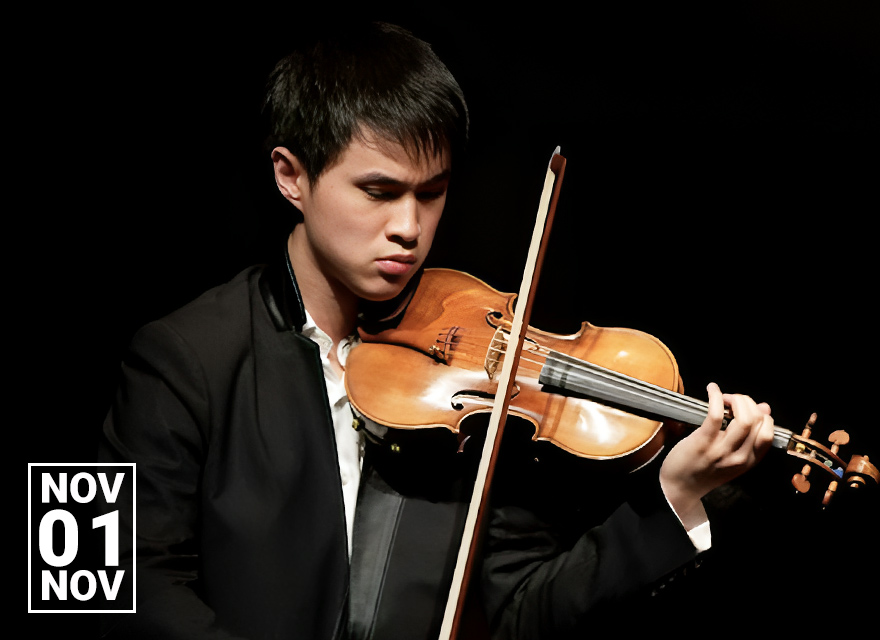
Kevin Zhu: Paganini’s "24 Caprices for Solo Violin"
SATURDAY, NOVEMBER 1, 2025 • 7:30PM
STAGE AT ST. ANDREWS • 6036 COBURG RD
HALIFAX, NOVA SCOTIA
WHEELCHAIR ACCESSIBLE
About this Concert
Violinist Kevin Zhu, an artist of boundless curiosity, presents his daring interpretation of Niccolò Paganini’s exhilarating "24 Caprices for Solo Violin." This electrifying performance unveils the violin’s full spectrum of virtuosity and emotion, each caprice a masterful blend of technical brilliance and expressive depth, meticulously crafted to captivate and astonish. With a keen ear for nuance and a fearless command of his instrument, Kevin Zhu transforms these iconic works into a vivid dialogue between past and present. Winner of the prestigious Paganini International Violin Competition, the violinist's profound connection to this repertoire is undeniable. Known for infusing each performance with imaginative phrasing and dynamic intensity, Zhu invites audience members into an intimate exploration of Paganini’s musical genius. Honed under the guidance of Itzhak Perlman at The Juilliard School, Zhu's artistry shines through in recitals at the Konzerthaus Berlin, London’s Royal Festival Hall, and Beijing’s Forbidden City Concert Hall, fusing spontaneity and soul into a breathtaking celebration of the violin’s limitless possibilities. Season Sponsor: Nice Moves / Red Door Realty.
This performance is made possible with the generous support of Frank Letourneau.
ARTIST: Kevin Zhu, violin
MAIN STAGE CONCERTS SERIES
About this Program
Niccolo Paganini was known as “The Devil’s Violinist” because his mastery of the violin was so outstanding that his gifts could only have come from the devil. But there are other explanations. His birth and upbringing were anything but diabolical. He was born in Genoa in 1782, the third of six children, to a ship’s chandler who worked on the side as a musician and mandolin seller. Young Niccolo was enamoured of the guitar which he learned to play as a five-year-old. His love of the guitar stayed with him his whole life; he always carried a guitar with him on tour, played it in private and in intimate settings and used it to sketch ideas for his compositions. But it was the violin that was his route to fame. He began playing at age seven, gave his first public recital as an eleven-year-old and toured northern Italy as a virtuoso at fifteen. By eighteen, he was famous. But only in northern Italy. And famous not only for his violin virtuosity but also for his lifestyle as a gambler and philanderer. He gained employment as a court musician (at the Tuscan court of Elisa Bonaparte, Napoleon’s sister), while keeping up his freelance career throughout northern Italy. It was not until the late 1820s, when he was in his forties, that he began to tour across Europe. In 1828, he undertook a three-year tour of the continent starting in Vienna and playing in every major city in Germany, Poland, Bohemia, France and England. And wherever he played, he created a sensation.
Paganini’s diabolical talent had a genetic component. He was tall and thin and had exceptionally long fingers which allowed him the ability to play three octaves across four strings in a hand span, an extraordinary feat even by today's standards. He also had tremendous agility; he apparently could play up to twelve notes per second, truly a diabolical tempo. He played his concerts – whether his own music or that of his contemporaries – with no music in front of him, playing entirely from memory and improvising freely. And he was not above using trickery to enhance his showmanship. For example, he would often cut one or two strings before a performance so that they would snap during the concert; he would continue playing on the remaining strings. His concerts were an event, and as much as people were aghast at the stories swirling around him, they flocked to his concerts and thronged him in the streets. And so his reputation comes down to us as the pre-eminent violin virtuoso of the Romantic Age, and classical music’s first great “rock star”.
Johann Sebastian Bach wrote two sets of preludes and fugues titled The Well Tempered Clavier (Books 1 and 2), with each set containing twenty-four pairs. Each pair was set in a different key, so that the entire set featured a piece in every major and minor key. Bach noted that they were composed “for the profit and use of musical youth desirous of learning, and especially for the pastime of those already skilled in this study.” Each of the Books was conceived as a grand project. Niccolo Paganini’s 24 Caprices do not share Bach’s grand design. They were not written as part of a single grand project. Paganini composed them over a fifteen-year period between 1802 (when he was twenty), and 1817 (when he was thirty-five). They were written in three sets, one of seven pieces, one of five, and one of twelve, and were gathered and published in 1820. Unlike Bach, they did not explore the range of key signatures; in fact, nine of the twenty-four are in either E major, E minor, or E flat major. Oddly, although Paganini was a performer first and foremost, there is no record of his having performed his Caprices as a part of his public concerts. They appear to be a set of etudes, each one exploring technical skills, many of which were his innovations, and were intended for the use of other artists. And other artists have been using them for over two hundred years. They have influenced the music of numerous composers including Brahms, Liszt and Rachmaninoff, each of whom has produced variations on Paganini’s themes. Their popularity in the concert hall is matched by their popularity in the recording studio; over eighty recordings of the complete Caprices have been published in the past seventy-five years.
Program notes by Larry Bent.
About the Artist
Kevin Zhu, violin
American violinist Kevin Zhu gained worldwide attention at age 11, taking 1st Prize at the 2012 Menuhin Competition, and six years later, 1st Prize at the Paganini Competition in Italy. His career has since taken him to renowned concert halls across the globe, ranging from the Konzerthaus Berlin and London’s Royal Festival Hall to the Forbidden City Concert Hall in Beijing, the Esplanade in Singapore, and Bozar Brussels.
A recipient of the 2021 Avery Fisher Career Grant, Kevin is praised for both “infinite delicacy” and “wild intensity” (RTBF Belgium), his playing acclaimed for “absolute virtuosity, almost blinding in its incredible purity” (L’ape musicale) and also “soul, character, an inner life, with meticulousness and a great deal of sensitivity” (Dresdner Neueste Nachrichten).
The 2025/26 season includes performances with the Winnipeg Symphony Orchestra, China National Symphony Orchestra, and Sofia Philharmonic, and recital appearances across the United States, Canada, Germany, Italy, Spain, China, and South Korea. Further highlights include concerto appearances in Paris and Madrid, and the world premiere of a new violin concerto by French composer Hugues Reiner.
Kevin was featured on ABC Eyewitness News, BBC Radio 3, and RAI Radio 3. He is a Violin Channel Artist and serves as the Culture Ambassador of the Lin Yao Ji Music Foundation of China. He studied with Itzhak Perlman and Li Lin at The Juilliard School, where he holds a Bachelor’s degree.
Kevin performs on the c1700 “ex-Petri” Antonio Stradivari violin, on loan from the Ryuji Ueno Foundation and Rare Violins In Consortium, Artists and Benefactors Collaborative.
Kevin Zhu : « 24 Caprices pour violon seul » de Paganini
SAMEDI 1 NOVEMBRE 2025 • 19h30
STAGE AT ST. ANDREWS • 6036 COBURG RD
HALIFAX, NOUVELLE-ÉCOSSE
ACCESSIBLE EN FAUTEUIL ROULANT
À propos de ce concert
Le violoniste Kevin Zhu, artiste à la curiosité sans bornes, présente son interprétation audacieuse des exaltants « 24 Caprices pour violon seul » de Niccolò Paganini. Cette interprétation électrisante dévoile tout le spectre de la virtuosité et de l'émotion du violon, chaque caprice étant un mélange magistral de brillance technique et de profondeur expressive, méticuleusement conçu pour captiver et étonner. Avec une oreille attentive aux nuances et une maîtrise intrépide de son instrument, Kevin Zhu transforme ces œuvres emblématiques en un dialogue vivant entre le passé et le présent. Lauréat du prestigieux concours international de violon Paganini, le violoniste est indéniablement lié à ce répertoire. Connu pour insuffler à chaque interprétation un phrasé imaginatif et une intensité dynamique, Zhu invite le public à une exploration intime du génie musical de Paganini. Formé sous la direction d'Itzhak Perlman à la Juilliard School, l'art de Zhu brille lors de récitals au Konzerthaus de Berlin, au Royal Festival Hall de Londres et au Forbidden City Concert Hall de Pékin, fusionnant spontanéité et âme dans une célébration époustouflante des possibilités illimitées du violon. Sponsor de la saison : Nice Moves / Red Door Realty.
Cette représentation est rendue possible grâce au soutien généreux de Frank Letourneau.
ARTISTE : Kevin Zhu, violon
SÉRIE DE CONCERTS SUR LA SCÈNE PRINCIPALE
À propos de ce programme
Niccolo Paganini était surnommé « le violoniste du diable » car sa maîtrise du violon était si exceptionnelle que son talent ne pouvait provenir que du diable. Mais il existe d'autres explications. Sa naissance et son éducation n'avaient rien de diabolique. Il est né à Gênes en 1782, troisième d'une fratrie de six enfants, d'un shipchandler qui travaillait également comme musicien et vendeur de mandolines. Le jeune Niccolo était passionné par la guitare, qu'il a appris à jouer à l'âge de cinq ans. Son amour pour la guitare l'accompagna toute sa vie ; il emportait toujours une guitare avec lui en tournée, en jouait en privé et dans des cadres intimes, et l'utilisait pour esquisser des idées pour ses compositions. Mais c'est le violon qui le rendit célèbre. Il commença à en jouer à l'âge de sept ans, donna son premier récital public à onze ans et fit une tournée dans le nord de l'Italie en tant que virtuose à quinze ans. À dix-huit ans, il était célèbre. Mais seulement dans le nord de l'Italie. Et célèbre non seulement pour son talent de violoniste, mais aussi pour son style de vie de joueur et de coureur de jupons. Il a été engagé comme musicien à la cour (à la cour toscane d'Elisa Bonaparte, la sœur de Napoléon), tout en poursuivant sa carrière indépendante dans tout le nord de l'Italie. Ce n'est qu'à la fin des années 1820, alors qu'il était dans la quarantaine, qu'il a commencé à faire des tournées à travers l'Europe. En 1828, il entreprit une tournée de trois ans sur le continent, commençant à Vienne et jouant dans toutes les grandes villes d'Allemagne, de Pologne, de Bohême, de France et d'Angleterre. Et partout où il jouait, il faisait sensation.
Le talent diabolique de Paganini avait une composante génétique. Il était grand et mince et avait des doigts exceptionnellement longs qui lui permettaient de jouer trois octaves sur quatre cordes d'un seul coup, un exploit extraordinaire même selon les normes actuelles. Il avait également une agilité extraordinaire ; il pouvait apparemment jouer jusqu'à douze notes par seconde, un tempo véritablement diabolique. Il jouait ses concerts – qu'il s'agisse de sa propre musique ou de celle de ses contemporains – sans partition devant lui, jouant entièrement de mémoire et improvisant librement. Et il n'hésitait pas à recourir à la ruse pour améliorer son sens du spectacle. Par exemple, il coupait souvent une ou deux cordes avant un concert afin qu'elles se cassent pendant le concert ; il continuait alors à jouer sur les cordes restantes. Ses concerts étaient des événements, et même si les gens étaient consternés par les histoires qui circulaient à son sujet, ils affluaient à ses concerts et se pressaient autour de lui dans les rues. C'est ainsi que sa réputation nous est parvenue, celle du violoniste virtuose par excellence de l'époque romantique et de la première grande « rock star » de la musique classique.
Johann Sebastian Bach a composé deux séries de préludes et fugues intitulées « Le Clavier bien tempéré » (livres 1 et 2), chacune contenant vingt-quatre paires. Chaque paire était composée dans une tonalité différente, de sorte que l'ensemble comprenait une pièce dans chaque tonalité majeure et mineure. Bach a noté qu'elles avaient été composées « pour le profit et l'usage des jeunes musiciens désireux d'apprendre, et surtout pour le divertissement de ceux qui maîtrisent déjà cette discipline ». Chacun des livres a été conçu comme un projet de grande envergure. Les « 24 Caprices » de Niccolo Paganini ne partagent pas la conception grandiose de Bach. Ils n'ont pas été écrits dans le cadre d'un seul et même projet de grande envergure. Paganini les a composés sur une période de quinze ans, entre 1802 (alors qu'il avait vingt ans) et 1817 (alors qu'il avait trente-cinq ans). Ils ont été écrits en trois séries, l'une de sept pièces, l'autre de cinq et la dernière de douze, puis rassemblés et publiés en 1820. Contrairement à Bach, ils n'exploraient pas toute la gamme des tonalités ; en fait, neuf des vingt-quatre sont en mi majeur, mi mineur ou mi bémol majeur. Curieusement, bien que Paganini ait été avant tout un interprète, il n'existe aucune trace de ses Caprices joués dans le cadre de concerts publics. Ils semblent être un ensemble d'études, chacune explorant des techniques, dont beaucoup étaient ses innovations, et étaient destinées à être utilisées par d'autres artistes. Et d'autres artistes les utilisent depuis plus de deux cents ans. Ils ont influencé la musique de nombreux compositeurs, dont Brahms, Liszt et Rachmaninov, qui ont chacun produit des variations sur les thèmes de Paganini. Leur popularité dans les salles de concert n'a d'égale que leur popularité dans les studios d'enregistrement ; plus de quatre-vingts enregistrements de l'intégrale des « Caprices » ont été publiés au cours des soixante-quinze dernières années.
Notes de programme par Larry Bent.
À propos de l'artiste
Kevin Zhu, violon
Le violoniste américain Kevin Zhu s'est fait connaître dans le monde entier à l'âge de 11 ans en remportant le premier prix du Concours Menuhin 2012, puis, six ans plus tard, le premier prix du Concours Paganini en Italie. Depuis, sa carrière l'a conduit dans les salles de concert les plus prestigieuses du monde, du Konzerthaus de Berlin au Royal Festival Hall de Londres, en passant par la salle de concert de la Cité interdite à Pékin, l'Esplanade à Singapour et le Bozar à Bruxelles.
Lauréat de la bourse Avery Fisher Career Grant 2021, Kevin est salué pour sa « délicatesse infinie » et son « intensité sauvage » (RTBF Belgique), son jeu étant acclamé pour sa « virtuosité absolue, presque éblouissante par son incroyable pureté » (L'ape musicale) et aussi pour « son âme, son caractère, sa vie intérieure, sa minutie et sa grande sensibilité » (Dresdner Neueste Nachrichten).
La saison 2025/26 comprend des concerts avec l'Orchestre symphonique de Winnipeg, l'Orchestre symphonique national de Chine et l'Orchestre philharmonique de Sofia, ainsi que des récitals aux États-Unis, au Canada, en Allemagne, en Italie, en Espagne, en Chine et en Corée du Sud. Parmi les autres temps forts, citons des concerts à Paris et à Madrid, ainsi que la première mondiale d'un nouveau concerto pour violon du compositeur français Hugues Reiner.
Kevin a été présenté dans ABC Eyewitness News, BBC Radio 3 et RAI Radio 3. Il est artiste du Violin Channel et ambassadeur culturel de la Lin Yao Ji Music Foundation of China. Il a étudié avec Itzhak Perlman et Li Lin à la Juilliard School, où il est titulaire d'une licence.
Kevin joue sur un violon Antonio Stradivari « ex-Petri » datant de 1700, prêté par la Ryuji Ueno Foundation et le Rare Violins In Consortium, Artists and Benefactors Collaborative.