


MAIN STAGE CONCERTS
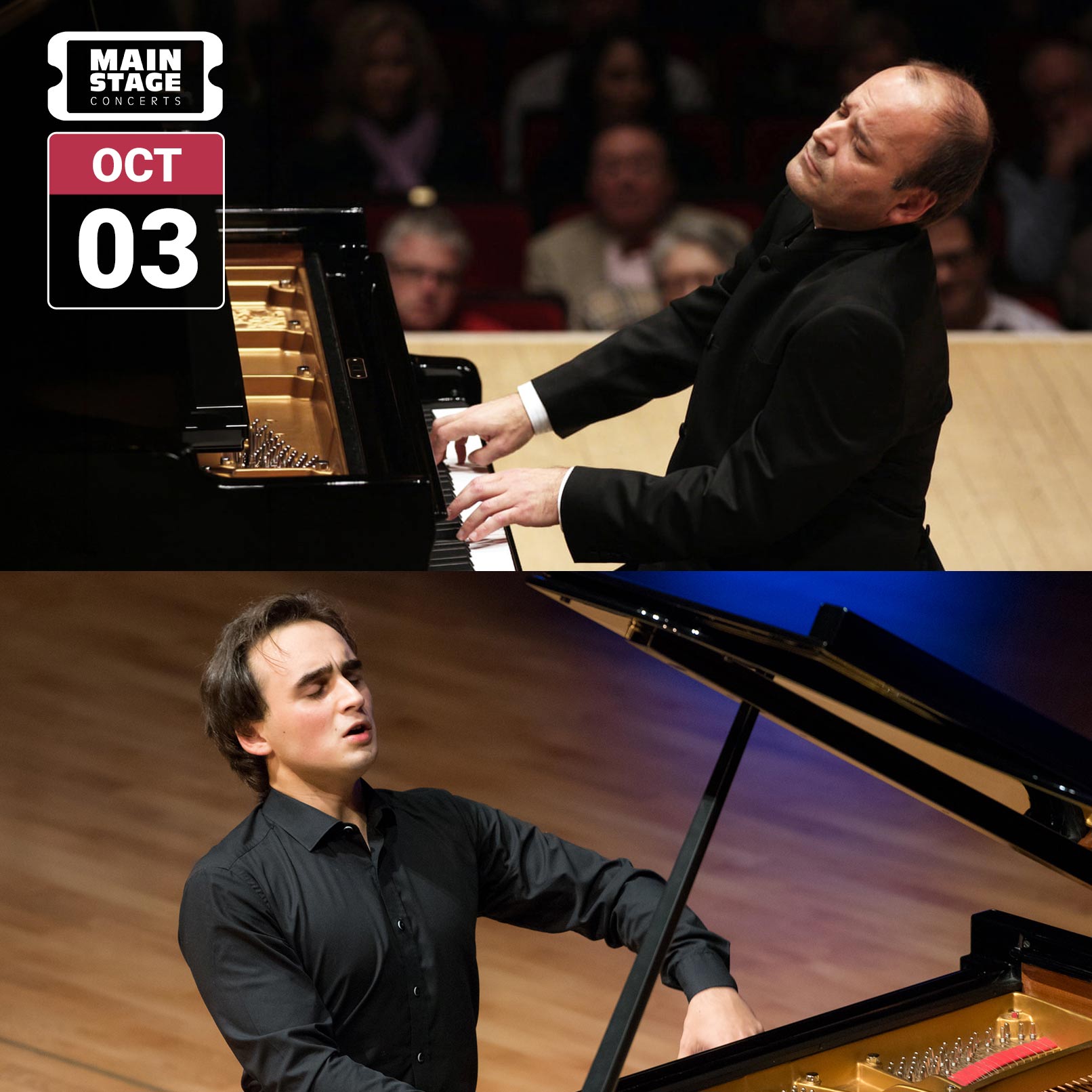
Pianists Louis Lortie & Illia Ovcharenko: Beethoven’s Symphony No. 9
Our 2026/27 Musician-in-Residence Illia Ovcharenko begins his three-concert residency alongside celebrated Canadian pianist Louis Lortie with Beethoven’s Symphony No. 9 in Franz Liszt’s arrangement for two pianos.
Saturday, October 3, 2026 • 7:30pm
Stage at St. Andrews (Halifax United Church)
Accessible Venue
Ticket Availability: Limited
Musician-In-Residence Presenting Partner: Lang Optometry & Eyewear
Season Sponsor: NICE MOVES / Red Door Realty

Program Information
Our 2026/27 Musician-in-Residence Illia Ovcharenko begins his three-concert residency alongside celebrated Canadian pianist Louis Lortie with Beethoven’s monumental Symphony No. 9, performed in Franz Liszt’s extraordinary arrangement for two pianos. Liszt created the two-piano version in 1851, translating Beethoven’s full orchestral score, including the famous “Ode to Joy” finale, to the combined resources of two pianists. At a time before recordings, arrangements such as this helped bring major orchestral works to audiences beyond the concert hall, and Liszt played an important role in establishing Beethoven’s symphonies at the heart of the concert repertoire. The concert marks Lortie’s first Halifax appearance in more than forty years. Long admired for the insight and individuality he brings to the piano repertoire, Lortie has performed with many of the world’s leading orchestras and in major halls across the globe. Ovcharenko has quickly built an international career with appearances at Carnegie Hall, the Concertgebouw, Wigmore Hall, and many other leading stages.
Ludwig van Beethoven (1770–1827)
Symphony No. 9 in D minor, Op. 125
(arr. for two pianos by Franz Liszt)
I. Allegro ma non troppo, un poco maestoso
II. Molto vivace
III. Adagio molto e cantabile
IV. Presto
Beethoven’s Symphony No. 9 in D minor is one of the best known and most frequently performed pieces in the Classical Music repertoire. The “Ode to Joy” theme from the fourth movement has been used as a patriotic anthem by Germany (East, West and Unified), the European Union, Rhodesia and South Africa. It has been used as a hymn (with reconstructed lyrics) by several Protestant denominations; it is traditionally performed as a year end celebration in Japan, and it has appeared as theme music for television news programs, for a sitcom (in a rock guitar version) and in TV automobile and airline ads.
The premiere of the Ninth Symphony in Vienna in May, 1824, has given rise to a host of stories, not all of which can be verified. For example, it is generally acknowledged that Beethoven was totally deaf by the time the symphony was premiered, yet he insisted on conducting the performance. As one of the violinists, Joseph Bohm, recalled, “Beethoven himself conducted, that is, he stood in front of a conductor’s stand and threw himself back and forth like a madman. At one moment he stretched to his full height, at the next he crouched down to the floor, he flailed about with his hands and feet as though he wanted to play all the instruments and sing all the chorus parts. – The actual direction was in Duport’s hands; we musicians followed his baton only.” At the end of the symphony, Beethoven was several bars off and continued conducting; the contralto Caroline Unger walked over and gently turned Beethoven around to accept the audience’s cheers and applause.
The symphony is regarded by many critics and musicologists as one of the supreme achievements in the history of music. It is a monumental work. It requires a full orchestra plus four vocal soloists and a substantial choir. The four movements take over an hour to perform. The four movements are as follows:
I. Allegro ma non troppo, un poco maestoso
II. Molto vivace
III. Adagio molto e cantabile
IV. Presto
Franz Liszt was a Nineteenth Century rock star. Adoring women would collapse swooning at his concerts. He virtually created the public piano recital, thus making music that had been available only to the upper classes accessible to the wider public. And since orchestral music was not readily available in pre-gramophone times, Liszt arranged many symphonic scores for solo piano, which he then performed on his concert tours. Among these were the fifth, sixth and seventh symphonies of Beethoven. (As a twelve year old, he won the approval of Beethoven by playing the great composer’s “Archduke Trio” for him, incorporating the violin and cello parts as he went along.) During the period from 1839 to 1847, he gave over 1000 concerts throughout Europe, Turkey, and Russia, often programming piano versions of symphonies. In 1848, Liszt withdrew from touring to allow more time for composition. In 1850, he completed his arrangement of Beethoven’s Ninth Symphony for two pianos. He published the full set of Beethoven’s nine symphonies arranged for solo piano in 1865.
Music critic Jed Distler, writing in Classics Today, noted that “Although Liszt’s solo-piano arrangement of Beethoven’s Ninth Symphony certainly is a virtuosic tour-de-force, his two-piano transcription more successfully addresses the score’s large dimensions in terms of textures, dynamics, colour, and, in the finale, more audible distinction between choral and orchestral forces."
Program notes written by Larry Bent
Renseignements sur le programme
Notre musicien en résidence 2026-2027, Illia Ovcharenko, amorce sa résidence de trois concerts aux côtés du célèbre pianiste canadien Louis Lortie avec la monumentale Symphonie no 9 de Beethoven, présentée dans l’extraordinaire arrangement pour deux pianos de Franz Liszt. Liszt réalisa cette version pour deux pianos en 1851, transposant toute la richesse de la partition orchestrale de Beethoven, y compris le célèbre finale de l’« Ode à la joie », aux ressources combinées de deux pianistes. À une époque où les enregistrements n’existaient pas encore, de tels arrangements permettaient de faire connaître les grandes œuvres orchestrales à un public au-delà des salles de concert, et Liszt joua un rôle important dans l’établissement des symphonies de Beethoven au cœur du répertoire de concert. Ce concert marque la première apparition de Lortie à Halifax depuis plus de quarante ans. Admiré depuis longtemps pour la perspicacité et l’individualité qu’il apporte au répertoire pianistique, Lortie s’est produit avec plusieurs des plus grands orchestres du monde et dans de prestigieuses salles partout sur la planète. Ovcharenko s’est rapidement bâti une carrière internationale, se produisant notamment au Carnegie Hall, au Concertgebouw, au Wigmore Hall et sur de nombreuses autres grandes scènes.
Ludwig van Beethoven (1770-1827)
Symphonie no 9 en ré mineur, op. 125
(arr. pour deux pianos de Franz Liszt)
I. Allegro ma non troppo, un poco maestoso
II. Molto vivace
III. Adagio molto e cantabile
IV. Presto
La Symphonie no 9 en ré mineur de Beethoven est l’une des œuvres les plus connues et les plus fréquemment jouées du répertoire de musique classique. Le thème de l’« Ode à la joie » du quatrième mouvement a servi d’hymne patriotique en Allemagne (de l’Est, de l’Ouest et réunifiée), ainsi que pour l’Union européenne, la Rhodésie et l’Afrique du Sud. Il a également été utilisé comme cantique, avec des paroles adaptées, par plusieurs confessions protestantes. Au Japon, il est traditionnellement interprété lors des célébrations de fin d’année. Il a aussi servi de thème musical à des bulletins de nouvelles télévisés, à une comédie de situation, dans une version pour guitare rock, ainsi qu’à des publicités télévisées pour des automobiles et des compagnies aériennes.
La création de la Neuvième Symphonie à Vienne, en mai 1824, a donné naissance à de nombreuses histoires, dont certaines ne peuvent être vérifiées. Par exemple, il est généralement admis que Beethoven était complètement sourd au moment de la création de la symphonie, mais qu’il insista néanmoins pour diriger l’exécution. Comme l’a raconté l’un des violonistes, Joseph Böhm : « Beethoven dirigeait lui-même, c’est-à-dire qu’il se tenait devant un pupitre de chef d’orchestre et se lançait d’avant en arrière comme un fou. À un moment, il se dressait de toute sa hauteur; l’instant suivant, il s’accroupissait jusqu’au sol. Il agitait les bras et les jambes comme s’il voulait jouer de tous les instruments et chanter toutes les parties du chœur. La véritable direction était entre les mains de Duport; nous, les musiciens, ne suivions que sa baguette. » À la fin de la symphonie, Beethoven avait plusieurs mesures de retard et continuait à diriger. La contralto Caroline Unger s’approcha alors de lui et le tourna doucement vers le public afin qu’il puisse recevoir ses acclamations et ses applaudissements.
La symphonie est considérée par de nombreux critiques et musicologues comme l’une des réalisations suprêmes de l’histoire de la musique. Il s’agit d’une œuvre monumentale. Elle exige un orchestre complet, quatre solistes vocaux et un chœur imposant. Ses quatre mouvements durent plus d’une heure. Les quatre mouvements sont les suivants :
I. Allegro ma non troppo, un poco maestoso
II. Molto vivace
III. Adagio molto e cantabile
IV. Presto
Franz Liszt était une véritable vedette du XIXe siècle. Des admiratrices en adoration s’évanouissaient lors de ses concerts. Il a pratiquement créé le récital public de piano, rendant ainsi accessible à un plus vaste public une musique jusque-là réservée aux classes privilégiées. Comme la musique orchestrale était difficilement accessible avant l’époque du gramophone, Liszt réalisa de nombreuses transcriptions de partitions symphoniques pour piano seul, qu’il interprétait ensuite au cours de ses tournées. Parmi celles-ci figuraient les cinquième, sixième et septième symphonies de Beethoven. (À l’âge de douze ans, il obtint l’approbation de Beethoven en lui jouant le « Trio à l’Archiduc » du grand compositeur, tout en intégrant les parties de violon et de violoncelle.) Entre 1839 et 1847, il donna plus de 1 000 concerts à travers l’Europe, la Turquie et la Russie, inscrivant souvent à ses programmes des versions pour piano de symphonies. En 1848, Liszt se retira des tournées afin de consacrer davantage de temps à la composition. En 1850, il acheva son arrangement de la Neuvième Symphonie de Beethoven pour deux pianos. Il publia en 1865 l’ensemble des neuf symphonies de Beethoven arrangées pour piano seul.
Le critique musical Jed Distler, écrivant dans Classics Today, a fait remarquer : « Bien que l’arrangement pour piano seul de la Neuvième Symphonie de Beethoven par Liszt constitue certainement un véritable tour de force virtuose, sa transcription pour deux pianos rend davantage justice aux vastes dimensions de la partition sur les plans des textures, de la dynamique, de la couleur et, dans le finale, de la distinction plus perceptible entre les forces chorales et orchestrales. »
Notes de programme rédigées par Larry Bent
Artist Biographies
Louis Lortie, piano
Louis Lortie has earned an international reputation as a versatile musician critically acclaimed for the fresh perspective and individuality he brings to the grand masters of the piano repertoire. In demand on five continents for more than thirty years, Louis Lortie performs with the most prestigious orchestras and in major concert halls around the world. A prolific artist, he has produced more than 45 recordings for Chandos Records featuring the pillars of piano literature. He is followed by more than 300,000 listeners monthly on streaming platforms and generated more than 6 million streams in 2022.
In Great Britain, his long-standing relationship with the BBC, the BBC Symphony and BBC Philharmonic orchestras have resulted in numerous recordings and concerts as well than more than ten invitations at the BBC Proms. In his native Canada, for half a century, he has regularly played with all the major orchestras: Montreal, Toronto, Vancouver, Ottawa and Calgary. Close collaborator of Kurt Masur, he was a regular soloist with the Orchestre National de France and the Gewandhaus orchestra during his tenure as Music Director. He has also collaborated with the Deutsche Sinfonieorchester Berlin, the Dresden Philharmonic Orchestra, the Leipzig MDR Orchestra in Germany and the United States, the Philadelphia Orchestra, the Dallas Symphony , San Diego Symphony, St. Louis Symphony, and New Jersey Symphony. Further afield, his collaborations include the Shanghai Symphony Orchestra where he was Artist in Residence, the Hong Kong Philharmonic Orchestra and the National Symphony Orchestra of Taiwan, as well as the Adelaide and Sydney Symphony Orchestras and the Orquestra Sinfônica do Estado de São Paulo in Brazil. Regular partnerships with chefs include, among others, Yannick Nézet-Séguin, Edward Gardner, Sir Andrew Davis, Jaap Van Zweden, Simone Young, Antoni Wit and Thierry Fischer.
In recital and in chamber music, Louis Lortie regularly performs at Wigmore Hall in London, the Philharmonie de Paris, the Concertgebouw in Amsterdam, Carnegie Hall, the Chicago Symphony Hall, the Beethovenfest Bonn and the Liszt Festival Raiding. He is particularly sought after for his integral of the Years of Pilgrimage of Liszt in one evening, the Etudes of Chopins (complete) in one evening, or his cycles of Beethoven sonatas; the latest one was filmed at the Salle Bourgie in Montreal and broadcast on Medici TV in 2021. For more than twenty years, with Hélène Mercier, the Lortie-Mercier duo has brought new perspectives on the repertoire for four hands and two pianos in concert as well as their numerous recordings.
His discography, exclusively for Chandos records, includes, in the solo piano repertoire, 7 volumes of works by Chopin, Beethoven’s 32 sonatas, the complete works of Ravel, Liszt’s Years of Pilgrimage and two volumes of works by Faure. With Edward Gardner he recorded Lutoslawksi’s Concerto and Variations on a Theme of Paganini with the BBC Symphony Orchestra, particularly praised by critics, as well as the complete concertos of Saint-Saens with the Orchester Philharmonique de la BBC or the Vaughan Williams concerto with the Toronto Symphony Orchestra and Peter Oundjian.
Louis Lortie is co-founder and Artistic Director of the LacMus Festival, which has been held yearly since 2017 on Lake Como. He was master in residence at the Queen Elisabeth Music Chapel in Brussels from 2017 to 2022; he continues to mentor pianists of exceptional talent by introducing the new generation through concert cycles, recently a cycle of Beethoven/Liszt symphonies at Wigmore Hall and the Dresden International Festival as well as the Scriabin Marathon at the LacMus and Bolzano Bozen Festivals .
Louis Lortie made his debut with the Montreal Symphony Orchestra at the age of thirteen, and in 1984 won the first prize of the Busoni competition and the fourth prize of the Leeds Competition. He studied with Yvonne Hubert (herself a student of the legendary Alfred Cortot ) and with Dieter Weber in Vienna, and then with Leon Fleisher. He was honoured with the title of “Officer of the Order of Canada” in 1992, and “Chevalier Ordre national du Québec” in 1997, and received an honorary doctorate from the University of Laval the same year.
Illia Ovcharenko, piano
When he was 6-years-old and living in Chernihiv, Ukraine, Illia Ovcharenko’s mother took him to hear a performance of Tchaikovsky’s first piano concerto. After the concert, Illia told his mother he wanted to be a pianist when he grew up.
Today, Illia Ovcharenko is one of the world’s most celebrated young pianists. Most recently, he won the Honens International Piano Competition in Calgary, Canada—a competition that seeks to identify the “Complete Artist”—someone who demonstrates technical mastery, perseverance against adversity, and an understanding of musical text that is both intellectual and emotional. Besides winning at the Honens International Piano Competition, one of the world’s most prestigious events of its kind, Ovcharenko has received prizes at more than 20 competitions throughout the world. These include, in the last four years, top prizes at the Kissinger Sommer “Klavierolymp” in Bad Kissingen, Busoni International Piano Competition in Bolzano, New York International Piano Competition, Hilton Head International Piano Competition, “Prix du Piano” Bern, as well as obtaining the “Michelangeli Prize” of the Eppan Piano Academy.
There wasn’t a lot of music in Illia’s household when he was growing up. Mom is a computer engineer, and Dad is an athlete and coach. But, there was an old upright piano in the corner of the living room, and Illia started plunking away as soon as he could reach the keys. He took singing lessons at 6-years-old, began formal piano studies at 9, and gave his first concert at 12 on the stage of the National Philharmonic of Ukraine.
His parents weren’t sure music was a terrific career path, but they encouraged his success. At 13, Illia went to study in Kyiv at a special high school for gifted musicians and later moved to Tel Aviv. He’s currently living in Hannover, Germany, where he’s finishing a master’s program with his longtime mentor, Arie Vardi. At the same time, Illia is a long time recipient at the International Musikakademie Liechtenstein.
For Illia, the piano is a real friend, sometimes filling him with joy, sometimes serving as a painkiller. The piano reveals who he is, to himself and to an audience. He thrives on live performance, feeling as if two souls—his and the composer’s—are united together on stage. He’s most at home playing romantic repertoire. Off the stage, Illia loves athletics (Roger Federer is an idol) and practices origami. In the future, Illia hopes to combine teaching with an international touring career.
He has appeared as a soloist with orchestras including the Deutsche-Symphonie Orchester Berlin, Israel Philharmonic, Edmonton Symphony, San Antonio Philharmonic, Orchestre National d’Île de France, the Orchestra of La Monnaie, the Toronto Symphony, Sinfonieorchester Liechtenstein, I Pomerrigi Musicali, Calgary Philharmonic, in recital at venues including Carnegie Hall, the Elbphilharmonie Hamburg, Konzerthaus Berlin, Wigmore Hall in London, Salle Bourgie in Montreal, Koerner Hall in Toronto and Salle Cortot in Paris.
Highlights of Ovcharenko’s 2025-26 season include performances at Wigmore Hall in London; Philharmonie de Paris, Klavierfestival “Le Piano Symphonique,” in Lucerne, Switzerland; National Polish Radio Symphony Orchestra in Katowice, Poland; Concertgebouw Amsterdam; Konzerthaus Berlin; Nova Scotia Symphony; and Bravo! Vail Music Festival. He will also perform on tour with the Orchestre National d’Île-de-France and the Youth Symphony Orchestra of Ukraine. The season will also see the release of the debut concerto recording on Pentatone label. His latest recital album, Whispers & Thunder, was released on the Steinway label and was named as ‘’One of the Best Classical Albums of 2025’’ by Gramophone Magazine and acclaimed by International Piano as “splendidly executed and smartly programmed” with Ovcharenko’s playing being described as “iron hands cloaked in mink gloves”. His previous solo album Litany, was released on Discauvers; Classique c’est cool praised Ovcharenko’s “very intelligently constructed program,” and the pianist’s “perfectly mastered technique.” The album also received high praise in Diapason and Pianiste magazines.
“I’m so happy when people hear me play and say I brought something new to their life or let them forget about their current troubles,” he says. “Playing the piano is usually a much better way of communicating since there is something intimate involved in this process.”
Biographies des artistes
Louis Lortie, piano
Louis Lortie s’est forgé une réputation internationale comme musicien polyvalent, salué par la critique pour le regard neuf et la personnalité qu’il apporte aux grands maîtres du répertoire pianistique. Très sollicité sur les cinq continents depuis plus de trente ans, Louis Lortie se produit avec les orchestres les plus prestigieux et dans les grandes salles de concert du monde entier. Artiste prolifique, il a réalisé plus de 45 enregistrements pour Chandos Records consacrés aux piliers de la littérature pianistique. Il est suivi chaque mois par plus de 300 000 auditeurs sur les plateformes de diffusion en continu et a généré plus de six millions d’écoutes en 2022.
En Grande-Bretagne, sa longue collaboration avec la BBC, le BBC Symphony Orchestra et le BBC Philharmonic a donné lieu à de nombreux enregistrements et concerts, ainsi qu’à plus de dix invitations aux BBC Proms. Dans son Canada natal, il se produit régulièrement depuis un demi-siècle avec tous les grands orchestres, notamment ceux de Montréal, Toronto, Vancouver, Ottawa et Calgary. Proche collaborateur de Kurt Masur, il a été régulièrement invité comme soliste par l’Orchestre national de France et l’Orchestre du Gewandhaus durant le mandat de Masur comme directeur musical. Il a également collaboré avec le Deutsches Symphonie-Orchester Berlin, l’Orchestre philharmonique de Dresde, le MDR-Sinfonieorchester de Leipzig et, aux États-Unis, avec le Philadelphia Orchestra, le Dallas Symphony Orchestra, le San Diego Symphony, le St. Louis Symphony Orchestra et le New Jersey Symphony. Ailleurs dans le monde, ses collaborations comprennent le Shanghai Symphony Orchestra, dont il a été artiste en résidence, le Hong Kong Philharmonic Orchestra et le National Symphony Orchestra de Taïwan, ainsi que les orchestres symphoniques d’Adélaïde et de Sydney et l’Orquestra Sinfônica do Estado de São Paulo, au Brésil. Parmi les chefs avec lesquels il collabore régulièrement figurent Yannick Nézet-Séguin, Edward Gardner, Sir Andrew Davis, Jaap van Zweden, Simone Young, Antoni Wit et Thierry Fischer.
En récital et en musique de chambre, Louis Lortie se produit régulièrement au Wigmore Hall de Londres, à la Philharmonie de Paris, au Concertgebouw d’Amsterdam, au Carnegie Hall, au Symphony Center de Chicago, au Beethovenfest Bonn et au Liszt Festival Raiding. Il est particulièrement recherché pour son interprétation en une seule soirée de l’intégrale des Années de pèlerinage de Liszt, de l’intégrale des Études de Chopin, ainsi que pour ses cycles de sonates de Beethoven. Le plus récent a été filmé à la Salle Bourgie de Montréal et diffusé sur medici.tv en 2021. Depuis plus de vingt ans, aux côtés d’Hélène Mercier, le Duo Lortie-Mercier apporte de nouvelles perspectives au répertoire pour piano à quatre mains et pour deux pianos, tant en concert que dans ses nombreux enregistrements.
Sa discographie, réalisée exclusivement pour Chandos Records, comprend, dans le répertoire pour piano seul, sept volumes consacrés à Chopin, les 32 sonates de Beethoven, l’intégrale des œuvres de Ravel, les Années de pèlerinage de Liszt et deux volumes consacrés à Fauré. Avec Edward Gardner et le BBC Symphony Orchestra, il a enregistré le Concerto pour piano et les Variations sur un thème de Paganini de Lutosławski, un enregistrement particulièrement salué par la critique. Il a également enregistré l’intégrale des concertos de Saint-Saëns avec le BBC Philharmonic, ainsi que le concerto de Vaughan Williams avec le Toronto Symphony Orchestra sous la direction de Peter Oundjian.
Louis Lortie est cofondateur et directeur artistique du LacMus Festival, présenté chaque année depuis 2017 au lac de Côme. De 2017 à 2022, il a été maître en résidence à la Chapelle musicale Reine Élisabeth de Bruxelles. Il continue d’accompagner des pianistes au talent exceptionnel et de faire connaître la nouvelle génération grâce à des cycles de concerts, notamment un récent cycle des symphonies de Beethoven/Liszt au Wigmore Hall et au Festival international de Dresde, ainsi que le Marathon Scriabine aux festivals LacMus et Bolzano Bozen.
Louis Lortie a fait ses débuts avec l’Orchestre symphonique de Montréal à l’âge de treize ans. En 1984, il a remporté le premier prix du Concours Busoni et le quatrième prix du Concours international de piano de Leeds. Il a étudié auprès d’Yvonne Hubert, elle-même élève du légendaire Alfred Cortot, ainsi qu’avec Dieter Weber à Vienne, puis avec Leon Fleisher. Il a été nommé « Officier de l’Ordre du Canada » en 1992 et « Chevalier de l’Ordre national du Québec » en 1997. La même année, l’Université Laval lui a décerné un doctorat honorifique.
Illia Ovcharenko, piano
À l’âge de six ans, alors qu’il vivait à Tchernihiv, en Ukraine, Illia Ovcharenko accompagna sa mère à une interprétation du Premier Concerto pour piano de Tchaïkovski. Après le concert, Illia lui annonça qu’il voulait devenir pianiste lorsqu’il serait grand.
Aujourd’hui, Illia Ovcharenko est l’un des jeunes pianistes les plus célébrés au monde. Plus récemment, il a remporté le Concours international de piano Honens à Calgary, au Canada, un concours qui cherche à reconnaître l’« artiste complet », soit un musicien qui fait preuve d’une maîtrise technique, de persévérance face à l’adversité et d’une compréhension à la fois intellectuelle et émotionnelle du texte musical. En plus de sa victoire au Concours international de piano Honens, l’un des événements les plus prestigieux du genre au monde, Ovcharenko a remporté des prix dans plus de 20 concours internationaux. Au cours des quatre dernières années, il a notamment obtenu les plus hautes distinctions au Kissinger Sommer « KlavierOlymp » de Bad Kissingen, au Concours international de piano Busoni de Bolzano, au New York International Piano Competition, au Hilton Head International Piano Competition et au « Prix du Piano » de Berne, ainsi que le « Prix Michelangeli » de l’Académie de piano d’Eppan.
La musique occupait peu de place dans la maison familiale d’Illia durant son enfance. Sa mère est ingénieure en informatique et son père est athlète et entraîneur. Il y avait toutefois un vieux piano droit dans un coin du salon, et Illia commença à en jouer dès qu’il fut assez grand pour atteindre les touches. Il prit des cours de chant à six ans, entreprit des études formelles de piano à neuf ans et donna son premier concert à douze ans sur la scène de la Philharmonie nationale d’Ukraine.
Ses parents n’étaient pas convaincus que la musique représentait un excellent choix de carrière, mais ils l’encouragèrent dans sa réussite. À treize ans, Illia partit étudier à Kyiv dans une école secondaire spécialisée pour jeunes musiciens doués, avant de s’installer plus tard à Tel-Aviv. Il vit aujourd’hui à Hanovre, en Allemagne, où il termine une maîtrise auprès de son mentor de longue date, Arie Vardi. Parallèlement, Illia bénéficie depuis de nombreuses années du soutien de l’International Music Academy in Liechtenstein.
Pour Illia, le piano est un véritable ami, qui lui apporte parfois de la joie et lui sert parfois d’antidouleur. Le piano lui révèle qui il est, à lui-même comme au public. Il s’épanouit dans les concerts devant public, avec le sentiment que deux âmes, la sienne et celle du compositeur, s’unissent sur scène. Il se sent particulièrement à l’aise dans le répertoire romantique. En dehors de la scène, Illia aime le sport, Roger Federer étant l’une de ses idoles, et pratique l’origami. À l’avenir, Illia souhaite conjuguer l’enseignement à une carrière internationale de concertiste.
Il s’est produit comme soliste avec des orchestres tels que le Deutsches Symphonie-Orchester Berlin, l’Israel Philharmonic Orchestra, l’Edmonton Symphony Orchestra, le San Antonio Philharmonic, l’Orchestre national d’Île-de-France, l’Orchestre de la Monnaie, le Toronto Symphony Orchestra, le Sinfonieorchester Liechtenstein, I Pomeriggi Musicali et le Calgary Philharmonic Orchestra. Il a également donné des récitals dans des salles prestigieuses, notamment au Carnegie Hall, à l’Elbphilharmonie de Hambourg, au Konzerthaus Berlin, au Wigmore Hall de Londres, à la Salle Bourgie de Montréal, au Koerner Hall de Toronto et à la Salle Cortot de Paris.
Parmi les faits saillants de la saison 2025-2026 d’Ovcharenko figurent des prestations au Wigmore Hall de Londres, à la Philharmonie de Paris, au festival « Le Piano Symphonique » de Lucerne, en Suisse, avec l’Orchestre symphonique national de la Radio polonaise à Katowice, en Pologne, ainsi qu’au Concertgebouw d’Amsterdam, au Konzerthaus Berlin, avec Symphony Nova Scotia et au Bravo! Vail Music Festival. Il se produira également en tournée avec l’Orchestre national d’Île-de-France et le Youth Symphony Orchestra of Ukraine. La saison verra aussi paraître son premier enregistrement de concerto sous l’étiquette Pentatone.
Son plus récent album de récital, « Whispers & Thunder », paru sous l’étiquette Steinway, a été nommé parmi les « meilleurs albums classiques de 2025 » par Gramophone. International Piano l’a qualifié de « superbement exécuté et intelligemment conçu », décrivant le jeu d’Ovcharenko comme des « mains de fer dans des gants de vison ». Son précédent album solo, « Litany », est paru chez DiscAuvers. Classique c’est cool a salué le « programme très intelligemment construit » d’Ovcharenko ainsi que la « technique parfaitement maîtrisée » du pianiste. L’album a également reçu des critiques élogieuses dans les magazines Diapason et Pianiste.
« Je suis tellement heureux lorsque les gens m’entendent jouer et me disent que j’ai apporté quelque chose de nouveau dans leur vie ou que je leur ai permis d’oublier leurs soucis du moment, dit-il. Jouer du piano est généralement une bien meilleure façon de communiquer, puisqu’il y a quelque chose d’intime dans ce processus. »
Location
Stage at St. Andrews (New Name: Halifax United Church)
6036 Coburg Road • Halifax, Nova Scotia • B3H 1Y9
Frequently Asked Questions
How will I receive my tickets?
Electronic tickets are emailed immediately after purchase to the email address used at checkout. Please keep your tickets handy on your smart phone or bring a printed copy with you to the concert so we can scan them at the door. If you do not receive your tickets, please check your spam or junk folder, as ticket emails are sometimes blocked or filtered by email providers. You may also wish to search your inbox for “Cecilia Concerts” or your order confirmation. If you still cannot find your tickets, please contact the Cecilia Concerts office before the concert and we’ll be happy to help. Rest assured, if you purchased tickets, your name will also be on our guest list at the door.
What time should I arrive?
Doors open at 7:00pm, and the concert begins at 7:30pm. We recommend arriving a little early so you have time to have your ticket scanned, find a seat, and get settled before the performance begins.
Can I arrive late?
Latecomers will be seated at an appropriate break in the performance, when possible. To avoid disruption to the artists and audience, we recommend arriving before the concert begins.
How long is the concert?
The approximate running time is 1 hour and 35 minutes, including a 15-minute intermission.
What is the seating like?
Tickets are general admission. The Stage at St. Andrew’s has unassigned seating, with chairs on the main floor and pews in the balcony. Seats are available on a first-come, first-served basis. Bravo Premium subscription holders have reserved access to seating within the first five rows. Please note that the balcony is accessible by stairs only. Wheelchair-accessible seating and companion seating are available on the main floor. If you have an accessibility-related seating need, please let us know when you arrive.
Are children welcome?
Yes, children are always welcome. Please keep in mind that this is a full-length concert in a traditional concert setting. Families may wish to choose seats close to a door in case a quick exit is needed during the performance.
What should I know about concert etiquette?
If you are new to classical concerts, you are very welcome. We simply ask that audience members help create a quiet and respectful environment for the artists and those around them. Please silence your phone before the concert begins, avoid talking during the performance, and wait for pauses between pieces to move around when possible.
When should I clap?
It is always fine to clap when a full piece has ended. Some longer works have several movements, with short pauses in between, and audiences usually wait until the entire work is finished before applauding. If you are unsure, it is perfectly okay to wait and follow the rest of the audience.
Can I use my phone during the concert?
Please silence your phone before the concert begins. We ask that phones and bright screens not be used during the performance, as they can be distracting to artists and audience members.
Can I take photos or videos?
Photos are welcome before or after the concert. Unless otherwise announced, photography, audio recording, and video recording are not permitted during the performance.
What accessibility features are available?
The Stage at St. Andrews is wheelchair accessible and includes accessible washrooms with ramp access. Companion seating is available if required. If you have a specific accessibility question before attending, please contact us and we’ll be happy to help.
Is the venue scent-sensitive?
To help make the concert comfortable for everyone, we ask guests to avoid wearing strong scents or fragrances.
Is there parking or public transit nearby?
The Stage at St. Andrews is located on the corner of Robie Street and Coburg Road. There is no parkade at the venue, but street parking is available in the surrounding area. The venue is also located near major South End Halifax Transit routes.
What happens if there is a storm?
If a storm may affect a performance, ticket holders are encouraged to call the Cecilia Concerts office at 902-423-0143 for a recorded concert update. Updates will also be posted on the Cecilia Concerts website and social media channels.
What happens if a concert is changed, postponed, or cancelled?
Concert schedule changes are very rare, but storms or other unexpected circumstances may occasionally require us to make adjustments. If a concert is changed, postponed, or cancelled, ticket holders will be contacted as soon as possible with available options. Depending on the circumstances, you may choose to attend the rescheduled concert, receive a credit toward a future Cecilia Concerts performance, request a refund, or convert the value of your ticket into a charitable donation tax receipt.